
 Tags:
Tags: 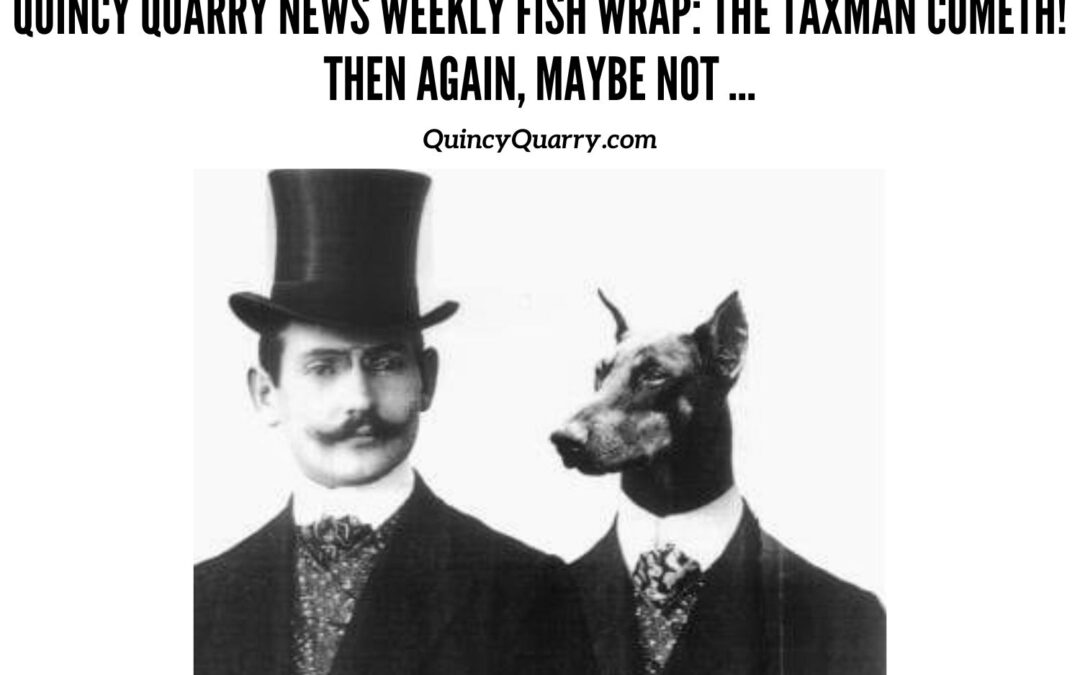
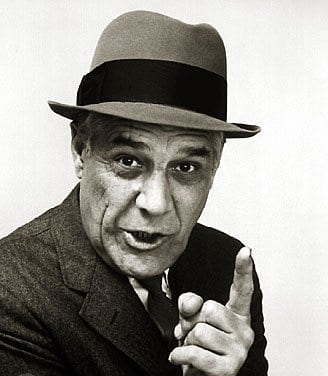
Herr Dobermann and his tax collection assistant
— Quincy Massachusetts News by Quincy Quarry News – News, Opinion and Commentary.

(“The worst day fishing is better then the best day at work”)
A file photo
After weeks to honestly more like months of not delivering the fish wrap, Quincy Quarry News personnel have recovered from their Thanksgiving food comas in time to weigh in on fat property tax hits looking likely to be body slamming local property owners come the start of fast approaching 2026 and when they are also facing their shopping holiday bills.
Unless, that is, one is a favored developer and surely but coincidentally also a substantial contributor to Quincy Mayor Thomas P. Koch’s campaign fund and so also surely but coincidentally scored a property tax break of one sort or another.
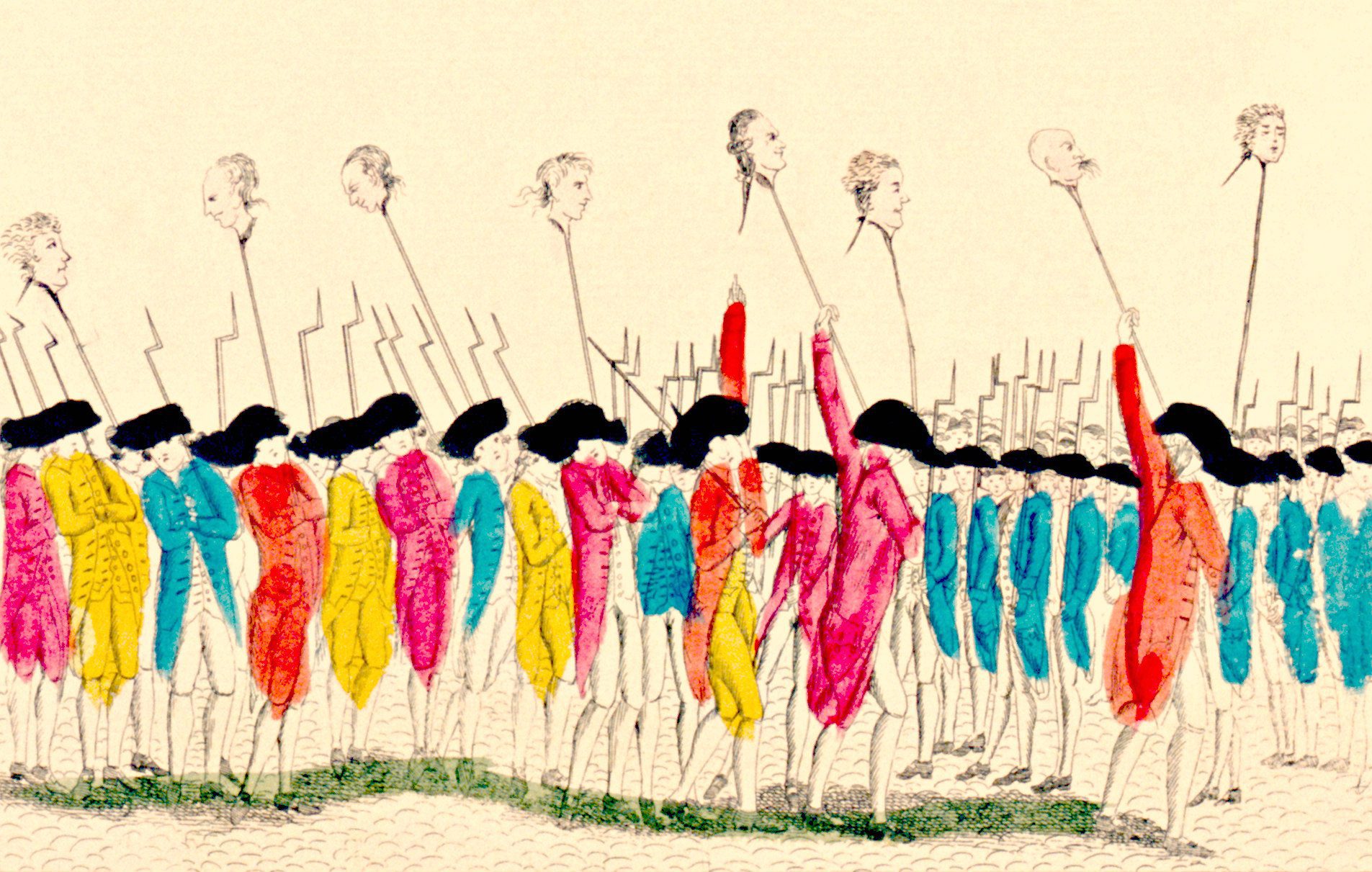
Disgruntled taxpayers hoisting the heads of lame ducks?
A file photo
In any event, the quants on Quincy Quarry’s financial and other affairs desk have long done what they can to divine what the Quarry’s ever-growing legions of loyal readers who are homeowners should expect in the way of property tax bill hikes come the start of 2026.
Granted, any word out of City Hall about what homeowners should expect in the way of increases in their property tax bills come the start of the year is at least as hard as extracting the truth out of the Koch Machine’s spokesmodel Pinocchio Walkbacker, let alone merely word out of him as to where he went to get a hair transplant over the summer.
Even so, the Quarry’s beancounters have read many cups’ worth of tea leaves to be able to suggest that local homeowners should be steel themselves for the very real potential of a 9.5% to as much as a bit over 13% increases in their Calendar Year 2026 property tax bills.

“A modest tax increase”
A file photo
Conversely, Quincy Mayor Thomas P. Koch is on record as expecting modest property tax increases in the fast approaching new calendar tax year.
At the same time, he has not offered up even merely a glint of a hint as to what he views to be “modest.”
Further, while the City Council is supposed to be addressing 2026 tax rates at its meeting this coming Monday night, there is arguable wiggle room in the proposed tax ordinances before the council that the exact increase may be delayed to the following Monday’s council meeting, if not later.
In short as well as no matter what …







Mayor Koch should STOP spending taxpayers’ money like it comes out of a water faucet.
We Taxpayers are getting hit from all sides by Mayor Koch (The Mooch)! Because of his reckless spending and giving favored real estate developers sweetheart tax breaks and other incentives, residential property owners are being hit with ever-increasing taxes every year!
I wish it was possible to have this Mooch recalled as Mayor! 🤑🫨🫨🫨
Pete,
An FYI: when Mayor Koch shall we say was OK with seeing the city charter changed such that mayoral term of office was increased from two to four years a dozen years ago, nothing appears to have been concurrently done to appropriately update local recall provisions.
Why now pose the need for updating local recall protocols?
Local recall provisions during the two year term era were minimal at best as it was felt that short two years were close enough to see a bad apple gone, however, a four year term changes things as pursuing a recall is pretty much not realistically possible, much less before factoring in any consideration of how the City Clerk would clearly appear to not certify petition signatures per local and state regs.
As a senior citizen, my fixed income sources are directly tied to the cost of living index (COLA). I can’t vote myself a hefty raise: a ten percent tax increase is far from modest. Please don’t remind me about tax relief offered. It isn’t going to compensate for yet another tax increase.
As far as the developers are concerned, it has been reported that some are exercising the option to pay into a fund supposedly for lower income housing. This is in lieu of.including those units into their projects. Where exactly is this money? And when will we see the promised lower income housing built? I am not talking about another housing project like Germantown, but something integrated into the community where residents aren’t isolated and labeled because of their financial status.
D C E H<
As for your asks, in-lieu of payments from developers to buy out their affordable housing obligation are deposited into the city's affordable housing trust.
Actual use of the funds has subsidized affordable housing in Quincy in a variety of ways as well as has been used to provide temporary housing or help with repairs needed as the result of natural disasters and such.
Even so, one could argue that disbursements from the trust have lagged.
Finally: you broached a good point: seeing affordable housing developed within typical neighborhoods as opposed to less well-off neighborhoods. FYI: such is federal policy, however, seeing such happen in Quincy is arguably not happening as many affordable housing projects have been shunted hither and yon is less than merely middling parts of the city.
Residents of Quincy deserve what they have: $1.6 billion dollar debt because mostly only the people working for the Mayor vote it’s a disgrace the % of people voting only runs around 20%. This happens All the time when people don’t vote, just move like I did. No one has to stay, it’s America.
Respectfully Chris, because is it America no one should have to move.